
10 Essential Bali ATM Withdrawal Tips: Avoid Fees & Scams
Master Bali ATM withdrawals with our guide on fees, safe locations, and exchange rates. Learn how to avoid skimmers and save on every transaction in 2026.
On this page
10 Essential Bali ATM Withdrawal Tips
Indonesian Rupiah looks intimidating on day one. A single 100,000 IDR note carries six zeros, prices on warung menus drop the last three digits without warning, and the ATM may demand a six-digit PIN you have never used. Get the mechanics right and Bali is one of the easiest cash economies in Southeast Asia to navigate. Get them wrong and you can lose a card to a "cash-first" machine or burn 8 percent of every withdrawal to Dynamic Currency Conversion before you have left the airport.
This guide covers the 10 things that actually move money in your pocket: which banks to trust, which to skip, the exact PIN and DCC steps, withdrawal limits per machine, the QR-code payment system Indonesia rolled out island-wide, and how to leave the country without a useless wad of small Rupiah. For the wider planning context, see our bali travel hacks pillar guide.
What Is The Currency in Bali?
Indonesia uses the Indonesian Rupiah (IDR or "Rp") and by law no merchant is allowed to accept payment in USD, AUD, or EUR. Coins exist for 100, 200, 500, and 1,000 IDR but locals rarely use them; banknotes run 1,000, 2,000, 5,000, 10,000, 20,000, 50,000, and 100,000 IDR. As a rough peg in 2026, 100,000 IDR is around 6 USD, 6 EUR, or 9.50 AUD. For live rates and exchange-window context, see our bali currency exchange tips.
Bali menus and price tags routinely drop the last three zeros, so "25k" means 25,000 IDR and "2,5jt" (juta = million) means 2,500,000 IDR. A bowl of nasi campur at a warung is 25k–40k, a Bintang at a beach club is 60k–90k, a Grab to Seminyak from Canggu is 40k–70k. Small operators rarely break a 100,000 note for a 30k purchase, so always carry a mix of 20s and 50s.
One legal detail most guides omit: you cannot bring more than 100,000,000 IDR in physical cash into Indonesia without filing a customs declaration. For tourists this is a non-issue (it is roughly 6,000 USD), but if you arrive with a year's worth of nomad savings in cash, you will be asked to declare it on the e-Customs form before passport control.
ATM Machines – Getting Cash Easily
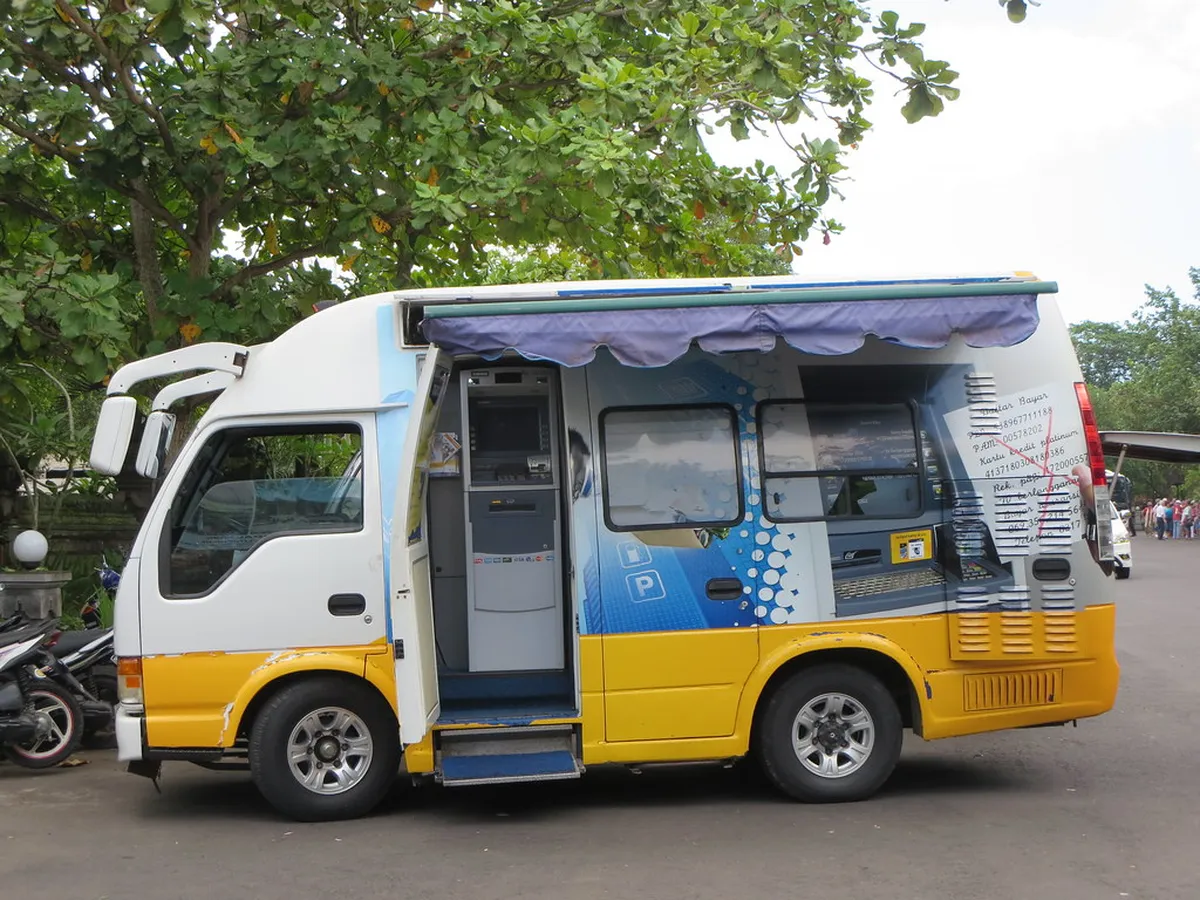
ATMs are dense across Kuta, Seminyak, Canggu, Ubud, Sanur, and Nusa Dua. Outside of those zones — north Bali, the east coast past Candidasa, Nusa Penida, the Gili Islands — they thin out fast and queues at the few working machines on payday weekends are real. Pull cash before you head out of the south. Ngurah Rai International Airport has bank-owned ATMs in both arrival halls and they are safe; rates there are slightly worse than in town but acceptable for the first 500k–1M IDR you need to pay for your bali airport transfer denpasar.
The non-obvious detail: many Indonesian ATMs dispense cash before returning the card. Western muscle memory says grab the bills and walk away — and that is how most lost cards happen here. Wait for the screen to return to the main menu, hear the card eject, and physically retrieve it before stepping back. If you do leave a card behind, the machine swallows it after 30 seconds and only the issuing bank can release it during business hours.
- Airport ATMs (Ngurah Rai) — bank-owned, 24/7, security on-site. Safe but a slightly worse rate; pull only what you need for the transfer and first night.
- Bank-branch vestibules (BCA, Mandiri, BNI, BRI) — the gold standard. CCTV, security guard, staff inside business hours, lowest skim risk.
- Convenience-store ATMs (Circle K, Indomaret, Alfamart) — usable in busy lit locations but often out of cash; many are leased to third-party operators with surcharges.
- ATM galleries (rows of machines at gas stations, supermarkets) — the highest skimming target. Acceptable inside Pepito or major malls, otherwise skip.
- Standalone street kiosks — only use them if they are in a busy, well-lit, CCTV-covered location. Anywhere quiet, walk away.
Bank Comparison: BCA, Mandiri, BNI, BRI
Not all Indonesian banks behave the same way at the ATM. Per-transaction limits, note size, and reliability differ enough that it is worth knowing which logo to look for before you walk in. The four big domestic networks below are the ones you want; foreign-owned ATMs (Commonwealth Bank, HSBC, Citibank) tend to apply worse exchange rates unless you hold a card from that exact bank.
- BCA (Bank Central Asia) — largest network in Bali, very reliable, machines typically dispense 50k or 100k notes. Per-transaction limit usually 1.25M IDR (50k machines) or 2.5M IDR (100k machines). Cleanest English-language UI of the four.
- Bank Mandiri — second-largest network, mostly 100k-note machines, per-transaction limit up to 3M IDR. Slightly higher daily withdrawal cap than BCA in most branch ATMs.
- BNI (Bank Negara Indonesia) — solid coverage in tourist zones and at the airport, mixed 50k/100k inventory, per-transaction limit around 2.5M IDR. Good fallback if BCA is offline.
- BRI (Bank Rakyat Indonesia) — heaviest rural coverage; useful in north Bali, Nusa Penida, and inland villages where the others thin out. Per-transaction limit 1.25M–2.5M IDR.
- Avoid — Commonwealth Bank ATMs (poor FX margin), generic ATM-gallery boxes branded "ATM Bersama" with no bank name, and microfinance/BPR rural ATMs that often reject foreign cards entirely.
Whatever bank you pick, plan around the 6,000,000 IDR all-in daily ceiling most networks impose. If you need more for a villa deposit or a cash-only diving package, you will need to spread withdrawals across two cards or two days.
ATM Operator Fees and Bank Charges
Indonesian bank-owned ATMs usually do not add an operator surcharge for foreign cards — that is the good news. The bad news is that your home bank almost certainly does, and the layered cost is what eats your budget: a flat foreign-ATM fee (typically 3–5 USD per pull), a foreign-transaction percentage (1–3 percent), and an FX margin baked into the conversion if you let your bank handle it. The third-party guide ATM Fee Saver - Indonesia Guide tracks the latest per-bank surcharges if you want to verify.
The single biggest fee-saver is to make fewer, larger withdrawals. One 2.5M IDR pull beats five 500k pulls every time when your home bank charges a flat fee. A travel-class card (Wise, Revolut Plus or higher, Charles Schwab in the US, Monzo or Starling in the UK, Macquarie or ING in Australia) will further compress the cost — most rebate or waive the flat fee within a monthly cap. Pair that with our bali on a budget complete guide and the cash-handling line on a two-week trip drops to single-digit dollars.
Notify your card issuer of your travel dates before you leave, or use an issuer that does not require notification. A blocked card on a Sunday evening in Ubud, when most banks are shut, is the worst possible outcome — and the reason every experienced Bali traveler carries at least two cards on different networks (one Visa, one Mastercard).
Exchange Rates and Dynamic Currency Conversion
Dynamic Currency Conversion (DCC) is the screen prompt that asks "Would you like to be charged in AUD/USD/EUR?" before the cash drops. Always decline. Always select "Continue Without Conversion" or the IDR option. DCC margins on Indonesian ATMs run 5–8 percent worse than your bank's mid-market rate, and the fee is invisible — there is no surcharge line on your statement, just a worse exchange rate burned into the principal.
The same rule applies at point-of-sale terminals in restaurants and shops. When the waiter brings a card machine showing two amounts (one in your home currency, one in IDR), point at IDR. The 2–3 percent surcharge that some venues add for credit cards is unavoidable, but the 5–8 percent DCC hit is entirely avoidable.
PIN Length and Card Compatibility
Indonesian-issued cards use a 6-digit PIN, so the keypad shows six empty slots. Your 4-digit international PIN works in every bank-owned ATM in Bali — type the four digits and press Enter. Do not pad with zeros. If a machine refuses your 4-digit code (extremely rare on BCA, Mandiri, BNI, or BRI), the issue is almost always a chip-read failure rather than length, so move to a different machine before assuming the card is dead.
For card networks, Visa and Mastercard work universally. Maestro and Cirrus are accepted at most bank ATMs but you should look for the logo before inserting. American Express is accepted only at premium hotels, a few luxury restaurants, and almost no ATMs. Discover and JCB are rare. Read our bali travel safety tips before you use any non-bank machine — physically wiggle the card slot, check for loose plastic shrouds over the keypad, and cover the PIN pad with your other hand while typing.
Credit Cards in Bali (Visa & Mastercard) Are Widely Accepted
Hotels, mid-range and upscale restaurants, dive shops, surf schools, larger boutiques, supermarkets (Pepito, Frestive, Grand Lucky), and the Bali airport all take Visa and Mastercard. Many small businesses tack on a 2–3 percent surcharge to cover the merchant-acquirer fee and pass that line to you on the bill — it is technically against the network's terms but routine in Bali and not worth arguing. See our breakdown of where plastic actually works at bali cash vs card acceptance.
Cash still wins at warungs, beach vendors, traditional markets, parking attendants, temple donations, taxi drivers without an app, and most homestays. A practical split for a one-week trip is roughly 60 percent card and 40 percent cash by spend, with the cash skewed toward food, transport, and tips. Tap-to-pay (Apple Pay, Google Pay) works at chain restaurants and supermarkets but is not universal — keep the physical card on you.
QRIS and Mobile Payments: What Tourists Can Actually Use
Indonesia rolled out QRIS, a single national QR-code payment standard, and by 2026 it is everywhere — warungs, parking attendants, even temple offering boxes. The catch for tourists is that QRIS is normally accessed through Indonesian e-wallets (GoPay, OVO, DANA, ShopeePay, LinkAja) that require an Indonesian phone number and KTP (national ID) to register. Most tourists cannot create those wallets directly.
What does work in 2026: cross-border QRIS via partner wallets from Singapore (DBS PayLah, OCBC Digital), Malaysia (Maybank, TNG), Thailand (most major banks), and South Korea. If you are flying in from one of those markets, your existing wallet will scan QRIS codes. Wise has begun rolling out QRIS for its Asian customers but coverage is patchy. For everyone else, cash and contactless cards remain the path. Knowing QRIS exists matters mostly so you understand why the warung owner waves a QR sticker at you — they are not refusing your cash, they are just showing the locals' default.
Withdrawal Limits and Multi-Pull Strategy
Per-transaction caps in Bali run 1,250,000 IDR on 50k-note machines and up to 3,000,000 IDR on 100k-note machines. The total daily ceiling at most networks is 6,000,000 IDR (around 380 USD) regardless of how many transactions you stack. Your home bank's daily limit is the other half of the equation — check it before you leave, since some retail debit cards default to a 200–500 USD daily international cap that will block your second pull. The Bank Negara Indonesia ATM locator lists every BNI machine in Bali with its note denomination if you specifically need 100k notes for a villa deposit.
Two practical scheduling notes most guides skip. First, BCA and Mandiri restock branch ATMs weekday mornings, so a Sunday-evening machine in Ubud or Uluwatu may already be empty after a busy weekend — withdraw Friday or Saturday morning if you need cash for the weekend. Second, the day before Nyepi (Balinese Day of Silence, March each year) is the single worst ATM day of the year because the entire island is locked down for 24 hours and locals withdraw maximums in advance. Get cash two days before Nyepi if your trip overlaps.
How to Exchange Cash and Spot Shady Money Changers
Authorized money changers in Kuta, Seminyak, Ubud, and Canggu often beat ATM rates by 1–3 percent and beat airport counters by 5–8 percent. The catch is that the cash-changer market in Bali contains a long-running sleight-of-hand scam where the clerk shortchanges you during a fast count, often with a partner distracting you. Sticking to authorized changers — they display a "Authorized Money Changer" / "PT Penukaran Valuta Asing" license — eliminates 95 percent of the risk. Trying an unmarked storefront is one of the classic bali first time visitor mistakes.
- Rate that beats the airport by more than 5 percent. Airport rates are the floor, not the ceiling. A "Today only!" rate dramatically above market is the bait.
- "No commission" sign with a worse posted rate. The commission is just baked into the FX margin instead.
- Cash counted out of your sight, behind glass, or with rapid hand movements. Always have it counted slowly in front of you, then count it yourself before you hand over your foreign currency.
- Re-counting after you have already verified. If they take the bills back to "recount," that is the moment a few are palmed. Walk away.
- Storefront in a side alley or attached to a tour-guide hustler. Authorized shops are on main roads, well-signed, with a posted licence number.
Before changing money, also check the condition of your foreign notes. Indonesian changers and banks reject any USD, EUR, or AUD bill that is folded, marked, torn, or pre-2009 series — even tiny ink marks on a 100 USD note get the entire bill refused or discounted by 5–10 percent. Bring crisp, post-2013 currency in 50s and 100s for the best rate. Smaller denominations (5s, 10s, 20s) get worse rates and many shops refuse them outright.
For leftover IDR at the end of the trip, exchange it before airport security on the way out — Bali changers give a far better rate on small IDR balances than your home country's banks (which often will not accept IDR at all). Keep 100,000–200,000 IDR for last-minute departure tax, taxi tips, or duty-free water, and convert the rest at an authorized changer in Kuta or near the airport.
Card Safety, Skimming, and the Freeze-After-Use Trick
The two-card rule is non-negotiable: a primary debit card on one network (e.g., Visa) and a backup on the other (Mastercard), stored separately. Add a credit card for emergencies but never use it at an ATM — credit-card cash advances trigger interest from day one and a separate cash-advance fee. Use a digital banking app like Wise or Revolut as the primary because they let you instantly freeze the card from your phone the second something looks wrong. Many full-time visitors in our canggu digital nomad guide freeze the card immediately after every street-ATM withdrawal, then unfreeze when they are about to use it again — a 10-second habit that defeats almost every skimming setup.
Before each withdrawal, run a five-second physical check: tug the card slot (a fitted skimmer often pops loose), look at the keypad bezel for a fitted overlay (slightly thicker than the original), glance up at the ceiling and overhead beam for a pinhole camera, and scan the area for a person watching too closely. If anything looks off, walk to the next machine. The fraud loss when a card is compromised is recoverable from your bank in most cases, but the trip-ruining 48 hours of disputes and waiting for a replacement card is not. If a machine swallows your card, call the issuing bank's emergency number first to lock the account, then visit the bank branch during business hours with your passport to request retrieval.
Final Thoughts On Bali Cash & ATMs
The compressed checklist: bring two cards on different networks, pick BCA / Mandiri / BNI / BRI bank-vestibule ATMs, decline DCC every time, wait for the card before walking away, plan around the 6M IDR daily ceiling and the Sunday/Nyepi cash droughts, and use authorized money changers with crisp post-2013 notes for any cash exchange.
Bali rewards a small amount of preparation with a frictionless cash experience for the rest of the trip. Pull a sensible amount on day one, keep a Plan-B card stashed in your hotel safe, freeze the primary card between uses if you are paranoid, and you can stop thinking about money and start enjoying the island.
Frequently Asked Questions
What is the best ATM to use in Bali?
The best ATMs to use in Bali are those located inside major bank branches like BCA, Mandiri, or BNI. These machines are regularly maintained and offer higher security compared to standalone street kiosks. You can find more safety advice in our bali travel safety tips guide.
Is it better to exchange money or use an ATM in Bali?
Using an ATM is generally better as it provides the most accurate exchange rate directly from your bank. However, you should use a travel-friendly card to avoid high international transaction fees. Authorized money changers are a good backup for exchanging physical cash in an emergency.
Can I use my Australian debit card in Bali?
Yes, most Australian debit cards work perfectly in Bali as long as they are part of the Visa or Mastercard network. You should notify your bank before traveling to prevent any security blocks. Be aware that some Australian banks may charge a fee for every international withdrawal.
How much cash can I withdraw from an ATM in Bali?
Most ATMs in Bali allow you to withdraw between 1.25 million and 3 million IDR per transaction. The specific limit depends on the bank and whether the machine dispenses 50,000 or 100,000 IDR notes. You can perform multiple transactions if your home bank daily limit allows it.
Are there many ATM scams in Bali?
While Bali is generally safe, skimming scams do occur at standalone ATMs in quiet or poorly lit areas. To stay safe, always use machines located inside banks or busy convenience stores and cover your PIN. Regularly monitoring your bank account through a mobile app helps you spot any issues quickly.
Managing your money in Bali does not have to be a stressful experience if you follow these simple withdrawal tips. By choosing the right ATMs and declining poor exchange rates, you can keep more of your budget for experiences. Always stay alert and prioritize your financial security while exploring the many wonders of this tropical paradise. We hope this guide helps you enjoy a safe and affordable journey through the beautiful island of Bali.