
8 Essential Bali Currency Exchange Tips for 2026
Master Bali currency exchange with tips on finding authorized changers, avoiding scams, and using ATMs safely. Includes the best places to exchange IDR in 2026.
On this page
8 Essential Bali Currency Exchange Tips
Bali runs on cash outside the big resorts, and the Indonesian Rupiah confuses first-time visitors with its long zeros and lookalike notes. The wrong choice at a backstreet money changer can cost you 10 to 15 percent of every transaction. This 2026 guide covers what to do at the airport, which authorized changers locals trust, how scams actually work, and how to use ATMs and travel cards without getting stung.
Bali received roughly 6.94 million international visitors in 2025 according to Statista: US Visitor Arrivals to Indonesia, and that volume keeps unlicensed changers in business across Kuta, Legian, and Ubud. Knowing the green PVA Berizin shield, the four-zero mental math, and the cash-first ATM sequence is the difference between a smooth trip and one that opens with a 200,000 IDR loss before you reach your hotel.
What is the Currency in Bali?
The official currency is the Indonesian Rupiah (IDR), written as Rp on price tags. Bank Indonesia issues notes from Rp 1,000 up to Rp 100,000, with deliberately distinct colors so you can tell them apart at a glance. Coins from Rp 100 to Rp 1,000 still circulate, mostly for parking attendants and warung change.
The notes you will actually use are the red Rp 100,000, blue Rp 50,000, green Rp 20,000, and purple Rp 10,000. Smaller bills (Rp 1,000, Rp 2,000, Rp 5,000) are gold for tipping, valet parking (Rp 2,000 to Rp 5,000), and street snacks. A frequent first-timer mistake is exchanging everything into Rp 100,000 notes and then hunting for change at every warung. Each denomination features a different national hero portrait and a tactile mark on the side for visually impaired users.
The Four-Zero Mental Math Shortcut
With early-2026 rates near 1 USD ≈ Rp 16,800, 1 AUD ≈ Rp 10,800, 1 GBP ≈ Rp 21,000, and 1 EUR ≈ Rp 18,000, you can do the math in your head: drop the last four zeros. A Rp 150,000 nasi goreng is roughly 15 AUD or 9 USD. A Rp 1,200,000 spa package lands near 120 AUD or 72 USD.
UK travelers drop four zeros then halve the result, since 1 GBP buys roughly twice as much as 1 AUD. EUR travelers use the USD trick with a small upward adjustment. Check the live mid-market rate on the Wise IDR Converter before exchanging. Authorized changers in Kuta and Seminyak trade within 1 to 2 percent of mid-market; if the gap is wider than 3 percent, walk to the next shop.
Where to Exchange Money in Bali Safely
Three names dominate the authorized scene: BMC (PT. Bali Maspintjinra), Central Kuta Money Exchange, and PT. Dirgahayu Valuta Prima ("Bali Best Rate"). All three run professional offices with security, electronic rate boards, printed receipts, zero commission, and branches in every tourist hub. BMC's main locations include Sanur (Jl. Danau Tamblingan No. 18), Seminyak (Jl. Raya Seminyak No. 16A), Legian, Kartika Plaza Kuta, and Kerobokan. Central Kuta's head office is at Jl. Sunset Road No. 168, Seminyak.
Indonesian banks (Bank Mandiri, BCA, BNI, BRI) also exchange currency with transparent rates but close by 15:00 on weekdays and offer slightly worse rates. Hotel front desks are 5 to 10 percent worse than BMC. For your first taxi or scooter, exchanging USD 50 to USD 100 at the bali airport transfer denpasar counter is fine; save the bulk for an authorized changer the next morning.
Airport vs. Authorized Changer vs. Hotel: A Quick Comparison
Each venue trades cost against convenience. Here is the rough trade-off:
- Ngurah Rai Airport counters: Open 24/7, accept all major currencies, but rates run 5 to 8 percent below mid-market. Use only for small "first taxi and SIM card" amounts under USD 50.
- Authorized high-street changers (BMC, Central Kuta, Dirgahayu): Best rates on the island, within 1 to 2 percent of mid-market, no commission, printed receipt, hours 08:30 to 21:00. Worth a 10-minute scooter ride.
- Hotel front desk: Convenient and safe but typically 5 to 10 percent below mid-market. Reasonable for a final emergency Rp 200,000 to Rp 500,000 after shops close.
- Bank branches (Mandiri, BCA, BNI, BRI): Transparent and safe, slightly worse rates, weekday-only hours that close around 15:00. Useful as a Sunday fallback.
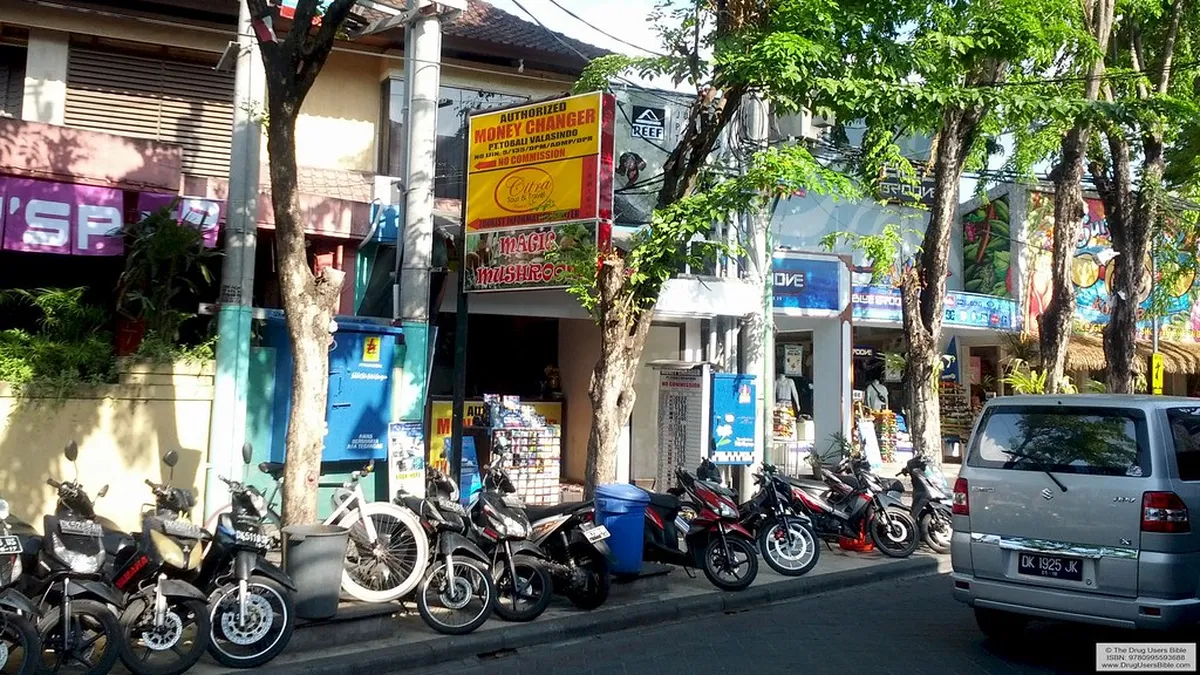
- Sidewalk and souvenir-shop changers: Avoid entirely. The "no commission" sign is usually paired with counting tricks.
How to Avoid Common Money Changer Scams
The PVA Berizin shield is your single most useful check. It is a green, shield-shaped sticker issued by Bank Indonesia, displayed in the window of every licensed changer with a registration number and often a QR code for verification. No shield means no transaction. Sidewalk booths and changers tucked into souvenir shops or sarong stalls almost never carry one.
Red flags to watch for:
- An advertised rate beating BMC or Central Kuta by more than Rp 500 to Rp 1,000 per dollar.
- "No commission" signs paired with vague rate boards. Reputable changers display rates with no asterisks.
- The teller stacking notes in piles of three or four, then re-counting rapidly with one hand below the counter (the classic sleight-of-hand).
- A calculator the shop hands you instead of letting you type the math yourself. Rigged calculators silently round in their favor.
- Pressure to complete the transaction quickly, especially during the final count.
Count the rupiah yourself in two passes: once by Rp 100,000 stacks, then verifying every individual note. If the count is wrong, never hand the money back; ask for the missing amount with the original stack still in your hand. Use your own phone calculator. See our wider list of bali tourist scams to avoid for related taxi, ATM, and art-market scams.
Tips for Using ATMs and Travel Cards in Bali
Indonesian ATMs follow a sequence that surprises almost every first-time visitor: they dispense cash before returning your card. Travelers grab the rupiah, walk away, and leave their card in the machine. Always wait for the screen to prompt you to take your card before stepping back.
A 5-point ATM safety checklist:
- Use ATMs inside bank branches, malls (Beachwalk, Discovery, Lippo), or 24-hour convenience stores. Avoid free-standing street machines, especially in Kuta back lanes.
- Wiggle the card slot and PIN pad before inserting your card. Skimmers are loose-fitting overlays.
- Shield the keypad with your other hand every time you type your PIN.
- If offered Dynamic Currency Conversion, always choose IDR. DCC adds a 6 to 7 percent hidden markup.
- Wait for your card to physically eject before walking away.
Withdrawal limits in Bali are typically Rp 1,250,000 to Rp 3,000,000 per transaction, with overseas-card fees of Rp 25,000 to Rp 50,000 per withdrawal on top of your home bank charges. Withdraw larger amounts less often. Notify your home bank before traveling, and check our bali atm withdrawal tips guide for the most reliable machines in each district.
Understanding Exchange Rates and Hidden Fees
Money changers display two rates: buying (what they pay for your foreign cash) and selling (the rate to convert rupiah back). For most travelers only the buying rate matters. As of early 2026, BMC and Central Kuta buy USD at roughly Rp 16,500 to Rp 16,700 against a mid-market of Rp 16,800.
The biggest hidden cost is Dynamic Currency Conversion at card terminals. When a waiter asks "Pay in IDR or USD?" they are offering DCC, where the merchant's terminal sets the rate with a 5 to 7 percent markup. Always answer "IDR." Card surcharges of 2 to 3 percent are also common at hotels and beach clubs. Beyond DCC and surcharges, your home card likely charges 1 to 3 percent foreign-transaction fees. A mid-market travel card (Wise, Revolut) eliminates this layer.
Wise vs. Revolut vs. Local Cash: Where Each Wins
A travel card pre-loaded with rupiah is the cleanest way to avoid foreign-transaction fees and DCC, but card acceptance varies dramatically by neighborhood. Wise charges the mid-market rate plus a small fee (around 0.5 percent on IDR), with free ATM withdrawals up to roughly 200 GBP or 350 AUD per month before a 2 percent fee kicks in. Revolut offers similar mid-market exchange with monthly fee-free thresholds by plan tier. Both add weekend markup per the Revolut Fee Schedule, so top up rupiah on a weekday.
Where cards work well: Seminyak, Canggu (Berawa, Pererenan), Nusa Dua resorts, Ubud center, beach clubs (Potato Head, Finns, Atlas), and supermarket chains (Pepito, Bali Deli). Where cash is essential: Ubud outskirts, Nusa Penida and Nusa Lembongan (limited ATMs, skimming reports), local warungs, traditional markets (Sukawati, Ubud Market), temple entrance fees, parking attendants, scooter rental, and Hindu ceremony donations. Rule of thumb: if the menu is handwritten or there is no air conditioning, assume cash only. Carry roughly Rp 1,500,000 to Rp 2,500,000 for a 2 to 3 day window, then top up. See our bali cash vs card acceptance guide for a neighborhood breakdown.
How Much Cash Should You Take to Bali?
A daily cash budget for a mid-range traveler is Rp 600,000 to Rp 1,000,000 (around USD 35 to 60), covering scooter fuel, warung meals, coffees, a spa or yoga class, and tips. Carry Rp 500,000 to Rp 1,500,000 on you and stash the rest in your room safe. Break Rp 100,000 notes into Rp 20,000 and Rp 50,000 bills at a supermarket or hotel front desk early on. Parking attendants expect Rp 2,000 to Rp 5,000; most temple entrances cost Rp 30,000 to Rp 75,000 per person. Read the bali tipping culture guide for typical amounts at restaurants and spas.
Decoy wallet strategy: keep a small folded stack of Rp 20,000 to Rp 50,000 notes (around Rp 200,000 total) in a front pocket for markets, taxis, and temples, with your main bills and travel card hidden separately. Pulling out a fat stack of Rp 100,000s at a market sets a high bargaining anchor and invites pickpockets. Splitting cash also limits the damage if a bag is lost.
How to Spot Counterfeit Indonesian Rupiah
Genuine Rp 100,000, Rp 50,000, and Rp 20,000 notes have a color-shifting security thread that switches hue when you tilt the bill; the Rp 10,000 note's denomination number changes color the same way. Counterfeits are typically printed on smooth, glossy paper rather than the rough cotton-fiber feel of real notes. If it feels like printer paper, it is.
Hold the note up to a light and check three things: the embedded watermark of the national hero on the right, the Rectoverso Bank Indonesia logo (small registers visible on both sides that align when backlit), and the embossed portrait, which has a slight raised texture. Reject notes that feel limp or look blurry, plus damaged-but-real notes (taped, torn at corners, badly stained), since warungs often refuse them later and you will be stuck holding the loss.
Note Condition and Balinese Money Etiquette
One thing other Bali currency guides skip: note condition matters more here than almost anywhere else in Asia. Warungs, parking attendants, drink stalls, and gas pump attendants routinely refuse notes that are torn, taped, deeply creased, or stained, even though they remain legal tender. Some changers quietly funnel their weakest stock to tourists. Inspect every note as you receive it; the phrase "Tolong tukar, ya?" (please swap, yes?) is universally understood.
Balinese cultural etiquette is worth a mention. Always hand cash with your right hand, or with both hands; the left hand alone is considered impolite. Place coins or notes onto an offering tray during temple visits rather than onto the ground. The small folded rupiah notes clipped into roadside Hindu offerings (canang sari) are not real legal tender; they are ceremonial copies, and picking them up is both rude and pointless. Carrying a stash of Rp 10,000 and Rp 20,000 bills also smooths the constant small transactions that fill a Bali day, since change is genuinely scarce island-wide.
What to Do if You Lose Your Cash or Cards
Act in the first 60 minutes. Open your banking app, freeze every active card, and screenshot the confirmation for any insurance claim. Wise and Revolut let you generate up to three replacement virtual cards within minutes, which you can add to Apple Pay or Google Pay and keep spending.
If the card was stolen, file a police report at the nearest Polsek (sub-district police office) before leaving the area. Travel insurance claims almost always require the written report (Surat Tanda Lapor Kehilangan), which takes 1 to 2 hours. Main tourist police posts are in Kuta (Jl. Raya Kuta), Legian (Jl. Padma), and Ubud (Jl. Raya Andong). Most hotels can call an English-speaking officer for you. For lost cash, your fastest options are a Western Union or MoneyGram transfer (agents in Kuta, Seminyak, Ubud, Sanur) or your hotel arranging a wire transfer. Always carry a backup card from a different bank in separate luggage. Review our bali travel safety tips for broader emergencies including lost passports.
For the full picture beyond this single topic, see our complete Bali travel hacks guide — it ties together transportation, money, where to stay, food, safety, and the rest of the practical decisions every Bali trip needs.
Frequently Asked Questions
What is the best place to exchange money in Bali?
The best places are authorized changers like BMC Money Changer and Central Kuta. These shops offer fair rates and are regulated by Bank Indonesia. Always look for the green PVA Berizin shield in the window. You can find more advice in our bali travel hacks guide.
Is it better to use ATMs or money changers in Bali?
Both options have benefits depending on your bank's international fees. ATMs provide convenience and current market rates, while money changers are great for swapping physical cash. Using a mix of both ensures you always have access to funds in remote areas.
How do I identify a fake money changer in Bali?
Fake changers often operate out of small, unmarked stalls or souvenir shops. They usually advertise rates that are much higher than the official bank rate. Legitimate shops will always provide a printed receipt and have a professional office environment with security.
Can I use US dollars in Bali?
Most local vendors only accept Indonesian Rupiah for daily transactions. Some high-end hotels or tour operators might quote prices in USD, but they usually convert it to IDR for payment. It is always better to carry local currency for markets and small cafes.
Mastering the rupiah is a small but high-leverage part of a Bali trip. Prioritize authorized PVA Berizin changers like BMC and Central Kuta, watch the ATM cash-then-card sequence, and reject DCC at every terminal. Carry a working mix of cash and a travel card like Wise or Revolut, keep a decoy wallet for markets and taxis, and use the four-zero mental math to track spending. The rupiah quirks become second nature within a day or two; the rest of Bali is yours.